uni
Ogni scheda di rete di un computer (NIC: network internet card) è identificata all’interno della rete tramite un indirizzo IP.
Un indirizzo IP è una sequenza di 32 bit, viene rappresentato con 4 numeri decimali (notazione decimale puntata).
IPv6 è a 128bit.
Maschera di Rete
Una maschera di rete è una sequenza di 32 bit.
Nella prima parte vengono messi ad 1 tanti bit quanti se ne vogliono dedicare alla rete.
Il numero di host
Per ricavare l’indirizzo di rete si usa l’operazione AND bit a bit tra maschera ed indirizzo IP.
IP protocol
3 IP: the internet protocol
This is one of the protocols that we can find at the network layer.
The IP protocol uses as support the 3.7 ICMP protocol: this handles error reporting and router signaling.
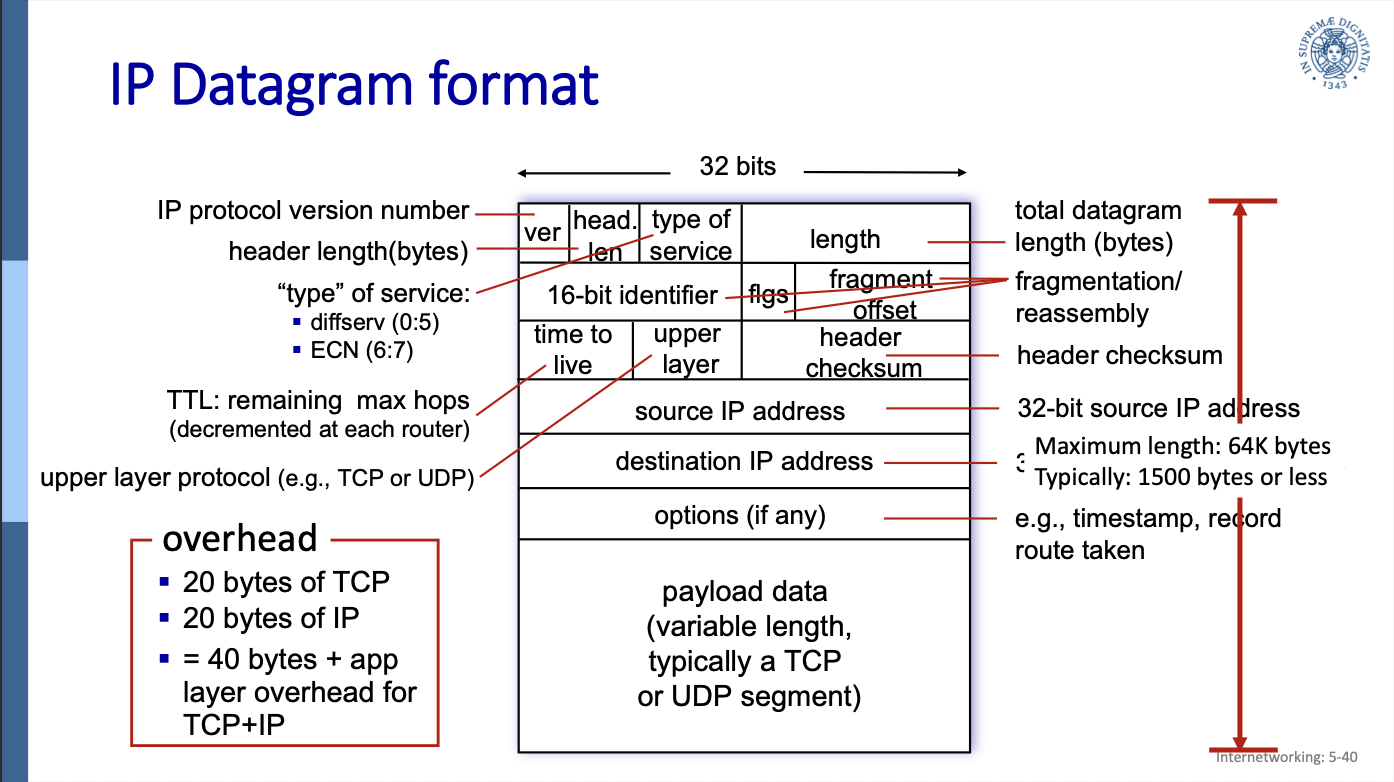
3.1 IP Datagram format
ver: the still most used version is the IP protocol version 4. In this field we always have to write 4.
header length in bytes
type of service (ToS)
- bits 0 to 5 represent diffserv: the priority
- bits 6 and 7 are used for ECN (not really used) (see 4.6.5 ECN explicit congestion notification)
- TTL: time to live, maximum number of forwards in routers before being dropped. It is decremented at each router.
length (16 bit: totale length of the datagram
upper layer protocol (the upper layer is the transport layer)
header checksum
source comes before destination because it isn’t like in the data link, where if the destination doesn’t match, the message is not listened to.
fragment offset (13 bit): the offset of the first segment in the original datagram
fragflag=1 means the current datagram is NOT the last fragment
overhead:
- 20 bytes of TCP
- 20 bytes of IP
- this gives a total of 40 bytes of overhead + any application layer overhead for TCP+IP
3.1.1 Fragmentation
A large datagram is fragmented in smaller datagrams and gets only reassembled at the final destination.
This is necessary because network links have an MTU (maximum transfer unit): the largest possible link-level frame.
Different link types have different MTUs.If not every fragment arrives in a determined timeframe, every fragment is dropped → lost datagram.
If the next link has a smaller MTU, it has to again fragment the fragments.
Fragmenting a 4000 bytes datagram for an MTU of 1500 bytes
- length=1500 (1480 bytes in data field) ID=x fragflag=1 offset=0
- length=1500 ID=x fragflag=1 offset=1480/8=185
- length=1040 ID=x fragflag=0 offset=370
3.2 Addressing
This is a 32-bit identifier associated with each interface of a host or router.
An interface is a connection between a host/router and the physical link.dotted-decimal IP address notation:
223.1.1.1 = 11011111 00000001 00000001 000000013.2.1 Subnets
A subnet is:
- a network of interface that can physically reach each oter without passing through an intervening router
- a network of interfaces that have in common the first high order bits of the IP address.
subnet mask: used to identify the subnet(s) of an address:
- subnet mask: /24 : the high order 24 bits of the address identify the subnet part of the IP address
mask: /24 = 11111111 11111111 11111111 00000000IP address Classes (IPv4)
- A = 8bits (subnet) + 24bits (host)
- B = 16+16
- C = 24+8
- D x multicast
- E x scopi futuri
These are not enough IPv4 addresses, and a lot of addresses are not used because of the classes.
3.2.2 Classless InterDomain Routing (CIDR)
The idea is the same, but now there are no classes and the address format is: where is the number of bit in the subnet portion.
3.2.3 How to obtain an IP address
Getting an IP address consists of two parts:
- how does an host get an IP address within its network
- how does a network get an IP address for itself
How a Host gets an IP address
For a Host an IP address is either:
- hard-coded by the sysadmin in the config file (in UNIX /etc/rc.config)
- DHCP
How a network gets a subnet
A network gets an allocated portion of its provider ISP’s address space.
For example an ISP has this block of addresses:
11001000 00010111 00010000 00000000 : 200.23.16.0/20
The ISP then allocates its address space in 8 blocks:
- 11001000 00010111 0001.0000 00000000
- 11001000 00010111 0001.0010 00000000
- 11001000 00010111 0001.0100 00000000
…
8. 11001000 00010111 0001.1110 00000000Normally though the ISP would’t fragment its address space in equal blocks, since different organization have different needs for addresses.
How an ISP gets a block of addresses
The ICANN (Internet Corporation for Assigned Names and Numbers) allocates IP addresses, through 5 regional registries (RRs), who may then allocate to local registries.
The ICANN also manages the DNS root zone, including the delegation of individual TLD (top level domain) management.3.2.4 Reflection on IPv4
ICANN allocated the last chunk of IPv4 addresses to RRs in 2011…
NAT helps IPv4 address space exhaustion.
IPv6 has a 128 bit (instead of 32) address space.3.3 Network Address Translation
With NAT all devices in a local network share just one IPv4 address from the outside world point of view.
This means every datagram that leaves a local network has the same source NAT IP address, but different source port numbers.Every device in a local network has a 32 bit address in a “private” IP address space, that can only be used in the local network, since these private IP address spaces only work in the local network and don’t comunicate with the outer internet.
These private IP address spaces are:
- 10/8
- 172.16/12
- 192.168/16
Advantages:
- all devices in a local network use ONE IP address
- can change ISP without changing addresses of devices in a local network
- security: devices inside a local network are not directly accessible by the outside world
3.3.1 Implementation
The NAT router must now keep a NAT translation table.
It must transparently:
- replace every source IP address and port number of every outgoing datagram to the NAT IP address and new port number
- remember every (source IP address, port number) to (NAT IP address, new port number) translation pair.
- for the incoming datagrams perform the inverse translation.
NAT translation table:
WAN address LAN address 138.76.29.7, 5001 10.0.0.1, 3345 138.76.29.7, … 10. … , … 3.3.2 NAT controversy
- routers should only process up to layer 3, instead it changes things from layer 4, address and port
- address shortage should be solved by IPv6
- violates end-to-end argument, information should be exchanged end-to-end, nobody in the middle should change this information, instead the router does
- NAT traversal: what if a client wants to connect to server behind NAT? → Port Forwarding: we have to insert manually a line in the NAT table, binding every (NAT address , port xx) to (server’s LAN address, port yy). So every request from outside coming for port xx, goes directly to the server, port yy.
3.4 IPv6
Why not IPv5? It was already taken by “string protocol”, but it failed.
This was introduced because 32 bits are not enough (IPv6 uses 128 bits) and an additional motivation was to speed up processing/forwarding: instead of a variable length header with IPv6 we can use a 40 byte fixed length header. Also this enables different network-layer treatment of “flows”.3.4.1 IPv6 datagram format
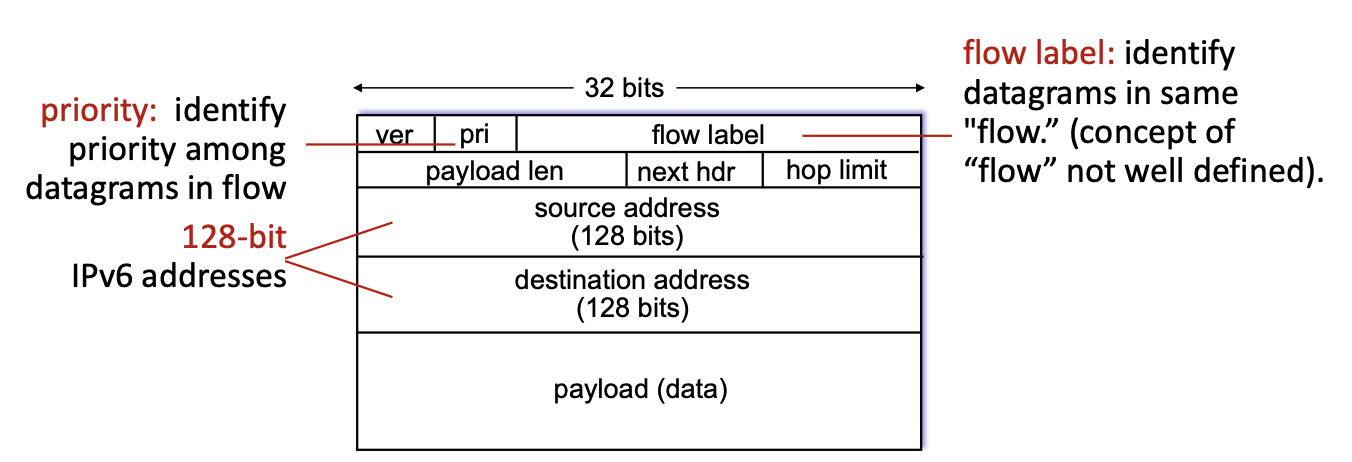
IPv6 datagram format:
- flow label: this identifies to which “flow” a datagram belongs
- pri: this indicated the priority of this datagram inside its flow
- hop limit: this is a different name for the TTL field, works exactly the same
- next hdr: in IPv4 we had a field that indicated the upper layer protocol, this is the same thing: inside the payload there is the header for the transport layer protocol, the “next header” field indicates what this header inside the payload is
the following is missing compared to IPv4:
- no checksum (to speed up processing): at every “hop” the checksum must be recomputed because the TTL (hop limit) gets decreased by one.
- no fragmentation: if a datagram is to big for this link, it gets discarded, we need to introduce a new message for “datagram too big”, to notify sender → need to make new 3.7 ICMP protocol, version 6, to introduce these new messages.
For IoT we introduce a new kind of fragmentation, because these links have really low MTUs.- no options: in IPv6 we now have a fixed length header!
3.5 Transition from IPv4 to IPv6
This transition has been going on for ~25 years: we cannot upgrade every router at once, how can the internet continue working with these two protocols coexisting?
3.5.1 Tunneling
The real answer is tunneling: the IPv6 datagram gets carried as a payload in a IPv4 datagram among IPv4 routers (“packet within a packet”).
Tunneling is also extensively used in other contexts (4G, 5G).Encapsulation
There are special routers that are split in 2, on side receives IPv6 packets, one side send IPv4 packets.
The IPv6 part receives a packet, extrapolates the data needed for building the IPv4 header, and passes the entire packet as the payload and the data for routing to the IPv4 part, which then builds the IPv4 packet and sends it forward.3.5.2 IPv6 Adoption
Google has estimated that ~45% of their clients access their services via IPv6 (as of 3 November 2024) (it was ~30% in 2020), worldwide data.
This data is very different by country though.NIST says ~1/3 of all US government domains are IPv6 capable.
3.6 ARP: Address Resolution Protocol
An ARP table is a table containing {MAC address , IP address} pairs of translation.
Each IP node (host, router) has an ARP table.ARP table:
IP address MAC address TTL ip address mac address Time after which the address mapping will be forgotten (typically 20min) 3.6.1 How to get a resolution pair
ARP: on the same LAN
If the sender doesn’t have the receiver’s MAC address in its ARP table, it broadcasts an ARP query packet, containing the receiver’s IP address.
All the hosts on the LAN receive this ARP packet, receiver included, which replies to the sender with its MAC address, and the frame is finally sent.The sender caches this IP-to-MAC pair in its ARP table, until this information becomes old (times out).
soft state: information times out unless refreshed.ARP is “plug and play”: the nodes create their ARP tables without intervention from the network’s administrator.
ARP: routing to another LAN
Walkthrough:
A wants to send a datagram to B, passing per router R.
Routers have a different ARP table for every LAN they connect to.
A creates IP datagram with source A, destination B
A uses ARP to get R’s MAC address for 111.111.111.110
A creates link-layer frame with R’s MAC address as dest, frame contains A-to-B IP datagram
A’s NIC sends frame
R’s NIC receives frame
R removes IP datagram from Ethernet frame, sees its destined to B
R uses ARP to get B’s MAC address
R creates frame containing A-to-B IP datagram sends to B3.7 ICMP protocol
This protocol is used by hosts and routers to communicate network-level information.
The ICMP protocol is above the IP protocol: ICMP messages are carried in IP datagrams.
But the IP protocol as well heavily relies on the ICMP protocol.3.7.1 ICMP messages
The ICMP messages contain:
- type
- code
- header + first 8 bytes of IP datagram causing the error
Link to original
Type Code Description notes 0 0 echo reply (ping) 3 0 dest. network unreachable 3 1 dest host unreachable 3 2 dest protocol unreachable 3 3 dest port unreachable 3 6 dest network unknown 3 7 dest host unknown 4 0 source quench (not used) not used anymore: used for rate control, for congestion (“you are going to fast, I’m gonna lose packets!“) 8 0 echo request (ping) 9 0 route advertisement 10 0 router discovery router announces itself as router 11 0 TTL expired when TTL (hop limit) expires 12 0 bad IP header IP header can get corrupted → checksum fails